The icon altar for St. Jodokus Church in Bielefeld
The prehistory:
For years I had been trying to obtain a
mediaeval winged altar, one that would be compatible with the church’s character, whose size would harmonize with the proportions of the choir area and the altar, whose brilliant colours would be a dignified adornment for the
altar and whose artistic value would be an exceptional treasure for our church.
All my endeavours to this end were unsuccessful. Yet a modern altar without a retabulum seemed to me to be irreconcilable with mediaeval
tradition. When I first saw the icons all together, I believed immediately to have discovered the perfect, albeit unusual and daring, solution. Moreover, I was overjoyed, when my suggestion thereof brought me the
enthusiastic approval of His Holiness, Cathedral capitulary, Professor Dr. Alois Fuchs of Paderborn, highly esteemed Nestorian of religious art in Westphalia.
1) The previous tabernacle was retained. After
creation of a seventeenth icon, a picture wall was placed in a simple oak frame in the style of a mediaeval winged altar, the measurements of which are proportionate to the size of the altar and the choir space. A small,
still missing part of the tabernacle had to be crafted by a local artist, because the iconographer was reluctant at this point to have his works misused “as a fill-in for a divine icon”.(!?). The small panel bears
the old sign of Christ in Greek (“Light and Life”).
The picture wall (iconostas) is necessary in the Eastern Orthodox Church to shelter the liturgical proceedings from the congregation and to conceal the
mystery from the eyes of the believers. The iconostas is intended to decorate the altar with the brilliance of its gold and the lustrous glow of it s rich colours, without rising arrogantly above it or even, - was the case in
later art with its pompous retabulae reaching up into the cupola – subjugating itself to the altar, which must always remain the focal point, and so degrading it.
Our picture wall retains its serving function; with its
moderate size it underlines the dignity of the altar as a select adornment. Even standing far below the altar in the church interior, one is able to recognize and understand the icons’ significance.
So it can
probably be considered a secular event that an icon altar, created by a Russian for us Germans, by an immigrant for us locals, by an Orthodox Christian for us Catholic Christians (Editor’s note: even though he didn’t
consider himself as such) was erected for the very first time in a Roman Catholic church in the first year of the Second Vatican Council led by the glorious “transitional Pope” John XXIII. Let us thank the
“artist” who created these works. He lives to this day in the way his great predecessors lived, who began each new creation with prayer and fasting day and night. Thanks to the originator of these icons in
the name of all generations, standing before these pictures in prayer and devotion. May the intention he himself defined for this donation - “To the honour of God with a prayer for the success of the Second Vatican
Council” – be passed on to all beholders of these icons!
1) Professor Dr. Fuchs gave a lecture at the annual meeting of the Society for Christian Art in the Archdiocese of Paderborn held on 26th June 1962 in
Bielefeld on the subject of the new icon altar. He also had an article published on the subject in the 1962 Annuals of that society, Bonifacius Printers, Paderborn). Click the button to read the article.
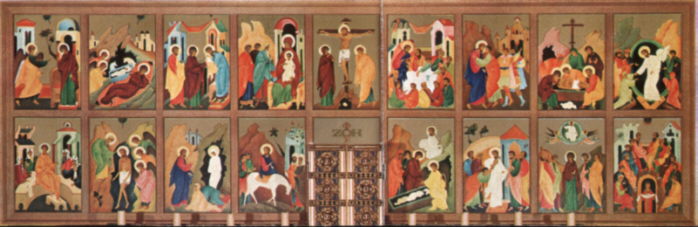
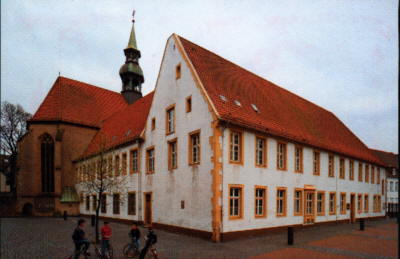
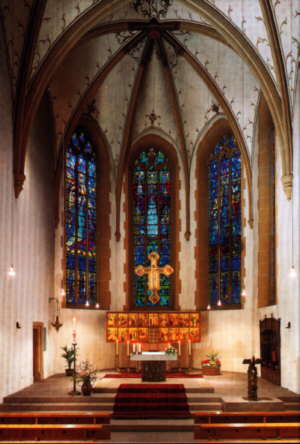
The icon altar in St. Jodokus Church, Bielefeld
by Heinrich
Sunder
This text appeared as a book in the publishing house RICHARD BENTRUP BIELEFELD.
Click the button!
Please key click
to far page 2